Key takeaways
- A healthy throttle position sensor sweeps smoothly from about 0.5 volts at idle to about 4.5 volts at wide open throttle.
- A dead spot in that sweep, even for a split second, means the sensor is wearing out and needs to come off the throttle body.
- Check the 5 volt reference and the ground wire before you blame the sensor for a stumble or a stored code.
- Corroded connector pins cause the exact same symptoms as a bad sensor, so clean and reseat the plug first.
- Most TPS replacements run 45 to 95 dollars in parts and about 20 to 30 minutes of labor once you know which wire is which.
The Maverick X3 idled fine in the driveway. Cold start, warm start, sitting at a stop, everything looked normal. The trouble only showed up on the trail, right around a quarter throttle, where the engine would stumble, flatten out, and sometimes stall completely.
A scan tool pulled a code: P0122, throttle position sensor circuit, low input. In plain terms, the computer thought the throttle had barely moved even when it was closer to half open. That mismatch between what the rider is doing and what the ECU sees is one of the more common faults on a side by side with real trail hours on it.
The throttle position sensor, TPS for short, is a small unit bolted to the throttle body with one job: tell the computer exactly how far the throttle is open. When the track inside wears, the symptoms look like a dozen other problems, a rough idle, hesitation, surging, a check engine light, or a computer that suddenly caps power and drops the machine into limp mode.
Testing it takes a multimeter, about 15 minutes, and a little patience with a back probe pin. Here is how to check the sensor itself, not just guess, before you spend 45 dollars or more on a part you may not need.
What the Throttle Position Sensor Tells the Computer
The TPS rides on the throttle shaft and turns with the butterfly plate inside the throttle body. Inside the housing sits a resistive track and a small wiper, the same basic idea as the volume knob on an old stereo receiver.
The ECU sends the sensor a steady 5 volt reference on one wire and reads a return signal on a second wire that rises as the wiper sweeps across the track. The third wire is ground. As the throttle opens from fully closed to wide open, that signal voltage should climb in a smooth, straight line, with no jumps and no gaps.
The computer combines that signal with input from the crank position sensor and, on many machines, the coolant temperature and manifold pressure sensors, to calculate fuel delivery and spark timing dozens of times a second. A signal that skips or drops out for even a fraction of a second throws that calculation off, and the engine feels it immediately as a stumble or a flare in RPM.
Signs Your TPS Is Starting to Fail
A failing TPS rarely quits all at once. Most owners notice a rough or hunting idle first, where the RPM climbs and falls on its own with the throttle untouched.
Hesitation or a flat spot under light throttle usually shows up next, often at the exact spot in the sensor’s travel where the internal track has worn thin. Some machines will surge at a steady cruising speed as the computer reacts to a signal that no longer tracks throttle position accurately.
On newer machines with electronic throttle control, a TPS fault can trigger limp mode, where the computer caps engine speed and power to protect the drivetrain until the fault clears. A stored code in the P0120 to P0123 range, or P0220 to P0223 on machines that use a second sensor for redundancy, points directly at this circuit.
Tools and Setup Before You Test
You need a digital multimeter that reads DC volts accurately to a tenth of a volt, a back probe pin or a small paperclip that fits beside the connector’s seal, and the wiring diagram for your machine if you can find one.
Find the throttle body first. On most UTVs it sits right off the airbox, fed by a cable or, on electronic throttle control machines, by a small drive motor. The TPS is the compact sensor with a three wire connector clipped to the side of the throttle shaft.
Leave the connector plugged in for this test. Back probing means sliding a thin pin into the rear of the connector alongside the existing wire, not through the wire’s insulation, so the circuit stays live and reads exactly as it does when you are riding.
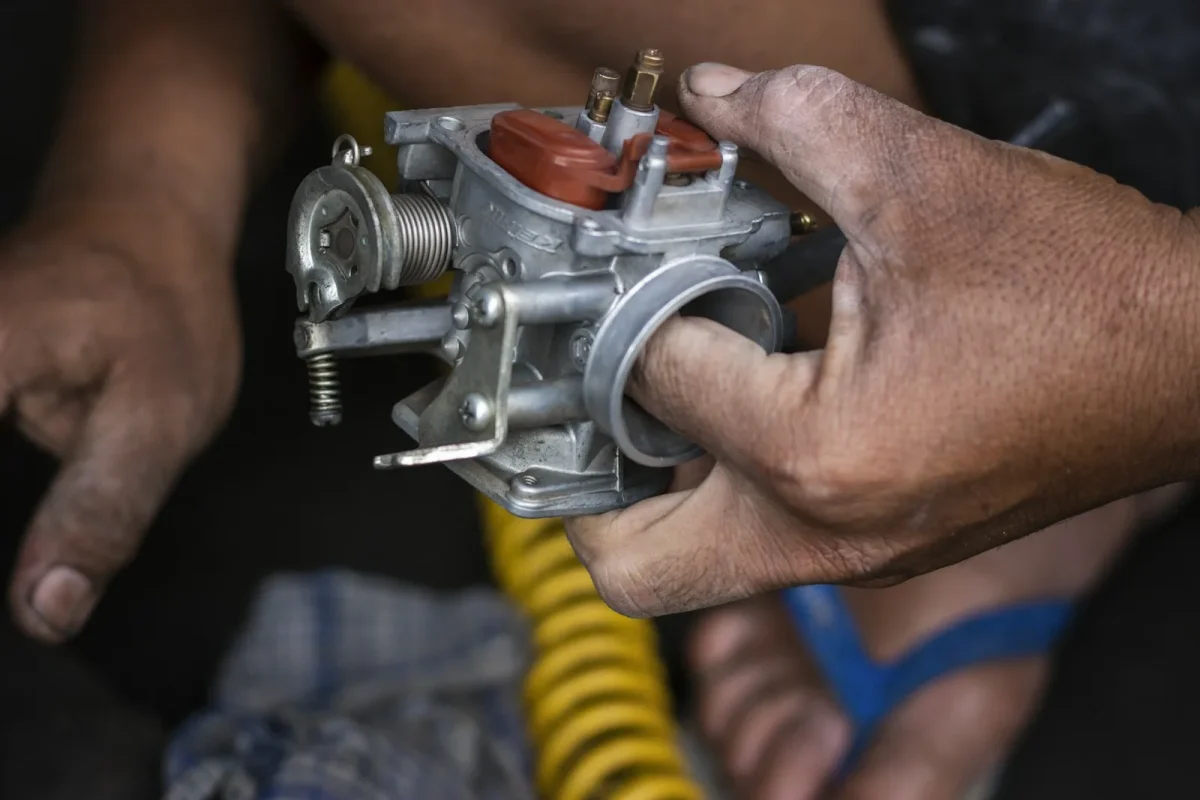
Reading the Voltage Sweep With a Back Probe
Turn the key on but do not start the engine. Set the meter to DC volts, clip the black lead to a clean ground point on the frame or the battery negative terminal, and back probe the signal wire, usually the middle wire on a three wire TPS connector.
With the throttle fully closed, you should read roughly 0.5 volts. Slowly move the throttle by hand, or have a helper press the pedal in one smooth, steady motion, while you watch the reading climb toward wide open throttle.
A healthy sensor sweeps smoothly to about 4.5 volts at wide open throttle, with no jumps, no flat spots, and no moment where the voltage drops toward 0 before recovering. That smooth, unbroken climb across the full range of throttle travel is the entire test. Anything else points at a worn or damaged sensor.
Tip
Move the throttle slowly, over 3 to 4 seconds, not in one quick snap. A worn spot in the sensor’s track can hide inside a fast sweep and only show up when you take your time.
Checking the 5 Volt Reference and Ground
Before you condemn the sensor itself, confirm it is getting good power and a clean ground. Back probe the reference wire with the key on and the sensor still connected. You should read close to 5 volts, generally between 4.75 and 5.25 volts.
A reference reading under 4.5 volts points at a wiring problem or a weak connection back at the ECU rather than a bad sensor. Check the ground wire next by measuring resistance from the ground pin, connector unplugged and key off, back to the engine block or frame ground. It should read under 2 ohms.
A high resistance ground, or a reference voltage that will not come up to spec, means the sensor can test as bad when the real fault sits upstream in the wiring harness or at a corroded ground strap.
TPS Voltage and Test Points by Model
Base voltage varies a little by brand and model year. Use the numbers below as a starting reference, then check them against your own machine’s service manual where you have access to one.
| Model | Closed throttle voltage | Wide open voltage | Adjustable at sensor |
|---|---|---|---|
| Polaris RZR 900/1000 (2015-2023) | 0.5-0.6V | 4.4-4.6V | No, fixed mount |
| Can-Am Maverick X3 (2017-2023) | 0.5-0.7V | 4.3-4.6V | No, electronic throttle |
| Yamaha YXZ1000R (2016-2022) | 0.56-0.66V | 4.4-4.7V | Yes, slotted screws |
| Kawasaki Mule Pro FXT (2015-2023) | 0.5-0.65V | 4.3-4.6V | Yes, slotted screws |
| Honda Talon 1000 (2019-2023) | 0.5-0.6V | 4.4-4.7V | No, electronic throttle |
TPS Test Checklist
Work through these steps in order before you order a replacement part.
- Confirm a stored code in the P0120 to P0123 range, or P0220 to P0223 on dual sensor machines
- Unplug the connector and check both halves for corrosion, green residue, or a bent pin
- Back probe the signal wire and watch for a smooth 0.5 to 4.5 volt sweep with no dead spots
- Confirm a 4.75 to 5.25 volt reference at the sensor with the key on
- Check ground wire resistance, it should read under 2 ohms
- Clear the code and road test before ordering a replacement sensor
Replacing a Failed Sensor and Getting Back on the Trail
Once you have confirmed a dead spot or a sweep that will not reach spec, replacement is straightforward on most machines. Two or three screws hold the sensor to the throttle shaft, torqued to about 15 to 18 inch pounds, light enough to snug down with a small driver.
Common mistake
Do not chase a TPS dead spot by adjusting the throttle cable or the idle stop screw. That changes where the engine idles, not what the sensor reports, and the dead spot will still be there the next time the throttle sweeps through that point.
On adjustable sensors, like the ones found on many Yamaha and Kawasaki throttle bodies, the mounting holes are slotted so you can rotate the sensor slightly to hit the base voltage spec before you tighten the screws down. Electronic throttle control units on newer Can-Am and Polaris models are not adjustable and bolt on in one position.
A new TPS runs 45 to 95 dollars for most side by sides, more if the throttle body comes only as a sealed assembly. After the swap, cycle the key on and off a few times without starting the engine, then start it and let it idle for a minute or two so the computer can relearn the new sensor’s baseline.

More than one Maverick owner has bolted on a brand new sensor only to find the real problem was a corroded pin in the connector. A dab of dielectric grease on clean pins and a firm reseat of the plug fixed what looked exactly like a bad sensor on the meter.
Confirm the sweep, the reference voltage, and the ground before you order a part. A TPS that fails this test earns its replacement. One that passes means the real fault, and the fix, is sitting somewhere else in the wiring, and now you know exactly where to keep looking.
Frequently asked questions
What voltage should a UTV throttle position sensor read?
A healthy TPS reads about 0.5 volts with the throttle fully closed and climbs smoothly to about 4.5 volts at wide open throttle. The 5 volt reference feeding the sensor should measure between 4.75 and 5.25 volts with the key on. Any dropout or flat spot in that sweep points at a worn sensor.
Can a bad TPS cause limp mode?
Yes. On machines with electronic throttle control, the computer will cap engine speed and power if the throttle signal does not make sense, which shows up as limp mode. A stored code in the P0120 to P0123 range, or P0220 to P0223 on dual sensor setups, usually confirms it.
Can I adjust a UTV TPS instead of replacing it?
Some machines, including many Yamaha and Kawasaki models, mount the sensor in slotted holes so you can rotate it slightly to hit the base voltage spec. Electronic throttle control units on newer Can-Am and Polaris machines are not adjustable and simply bolt on in one position.
How much does it cost to replace a UTV throttle position sensor?
Parts typically run 45 to 95 dollars depending on the brand and whether the sensor is sold separately or only as part of the throttle body. Labor usually runs 20 to 30 minutes for a bolt on sensor, longer if the throttle body itself needs replacement.
What fault codes point at the throttle position sensor?
Codes P0120 through P0123 cover the primary TPS circuit, while P0220 through P0223 point at a second sensor on machines built with redundant throttle position inputs. A code alone does not confirm the sensor is bad, so back probe the signal wire and check the sweep before you replace it.

Vidya Verma
Vidya Verma is a UTV and powersports technician with hands-on experience diagnosing electrical, charging, and starting problems on Polaris, Can-Am, and other side-by-side platforms. She writes practical, workshop-tested repair guides that help owners troubleshoot faults, choose the right parts, and get their machines running reliably in the field. When she's not under the hood, she's out riding trails and stress-testing the same fixes she recommends.